On the morning of the wedding, I was up before sunrise to make it in time for my hair and makeup appointment. I’d hardly slept the night before with all the nerves and excitement.
We’d had some small ritual ceremonies in the days prior, and today was the big day. I hadn’t been a part of the wedding planning at all, so I had no idea what to expect except that both the registration and religious ceremony would be taking place on the same day. I would have loved to have worn a Western-style, white wedding dress for the registry and an Indian saree for the traditional ceremony, but Maanav’s mother said I had to wear a traditional saree at both, so I didn’t argue with her. Maanav’s parents had organised everything.
My parents didn’t have a say in the wedding planning, but they still had to pay half of everything. The wedding was on Valentine’s Day, and the reception was the following month at a venue called The Colosseum, where we had around a thousand guests. I saw my father hand over a cheque for £20,000. This was a comfortable amount for Maanav’s family, but it left my parents in debt.
I later learned that my parents cashed in their life insurance policy and borrowed money to pay for my half of the wedding. I didn’t know any of this then. Perhaps Maanav’s family could have scaled back their plans for the sake of my family’s paucity, but Maanav was their only son, and they wanted to give him the best wedding he deserved at such short notice. They invited as many people as they wanted, ordered whatever they wanted, including specially flown-in roses from Holland because roses in bulk at the last minute were hard to come by on Valentine’s Day.
After around three hours of being primped, primed and poked with makeup brushes and what felt like hundreds of pins in my hair and saree, we headed off to the registry office, followed by a brunch, then a traditional Hindu/Jain wedding ceremony around the fire pit and a jolly, pot-bellied priest from India who turned out to be a stand-up comedian too.
I remember a couple of his jokes. He said he would share a mantra with us which would fix any problems we might stumble across in our marriage. This was the most important mantra for marriage, he said, and it would be good if we memorised it there and then. The magic mantra was… ‘Yes, dear.’ He also said that when Mrs. is angry at you for some reason, it’s best to stay calm, perhaps go for a walk. He then smiled and said that’s why he’s so healthy, he gets a lot of fresh air.
I smiled widely with joy throughout the ceremony. I mean, the priest was amazing and really funny, but I was told later that it was very unladylike for me to smile or look up. I didn’t get it; it was my wedding day, I was happy and in love, and yet I wasn’t allowed to show it. Apparently, a bride is supposed to act shy and demure and look down throughout the ceremony. What a load of nonsense, I thought. Who makes these rules that a man can do what he likes and a woman can’t smile at her own wedding? (Note, if you don’t want the bride to smile, don’t get a funny priest 😄)
The rituals were followed by a photo session with all the guests and a late lunch. Then it was time for the goodbyes. This is where the bride receives a final farewell hug from every member of her family.
When I’d attended Indian weddings in the past, I couldn’t understand all the howling and tears. They always cried as if they were never going to see each other again. How silly, I’d always thought. I swore I’d never cry at my wedding. Traditionally, in India, it made sense because the bride would travel to another village, and it was unlikely that she would see her family much, if ever again. But I was only going twenty minutes by car up the road, so why would I cry? Duh.
But, as soon as the goodbye song started, I started blubbering, howling, sobbing, yes, the lot, as if I were really being shipped off to a foreign land, completely unprepared for the new world and what lay ahead (perhaps there was some truth to this). All the emotion of everything I’d gone through with my family poured out unrelentingly. As difficult as it had been with my parents, in that moment, I felt like nothing but a tiny child being ripped out of her mummy’s safe, loving arms. I cried so much that some of Maanav’s family, his sisters especially, cried too. They knew what a journey I’d been on with my family and how emotional the whole situation was. Thank goodness for waterproof makeup.
As we made our way to the car, just as I was about to sit in it, my father appeared. He’d been quiet and had held back during the goodbyes under the wedding canopy. But now he was with me, his arms holding me tightly to him, hot tears streaming down his cheeks, and he kept repeating, “Sorry, Sorry… I’m sorry.” It was the moment I’d been waiting for, the moment I’d hoped for ever since I could remember. Perhaps I would have preferred it in private, and perhaps it would have been good to have had a proper conversation instead of this in front of almost everyone we knew, but I was touched that I finally got an apology from him.
As he settled me into the car, he placed a glittery, purple gift box, around the size and shape of a pillow, on my lap. We drove off.
The day was over for my side of the family, but the evening with Maanav’s family, my new family, lay ahead. The bride heads to the groom’s home, where she is officially welcomed, and they play ceremonial icebreaker games. Then some more rituals are performed, and the couple receive blessings from all the elders, and then dinner.
As I walked up the stairs at the end of the night, my legs wobbled, and they buckled the moment I entered our bedroom. I’d bent down and stood up so many times to touch the feet of all the elders in Maanav’s family that my legs had finally gone on strike and given up on me.
While Maanav was in the bathroom, I sat on the floor in front of the mirror, fishing for the hundred pins in my hair. I burst into tears again. This time is was out of sheer exhaustion. Maybe this is why they say get married first and then get pregnant, because you simply don’t have the energy to do it the other way around.
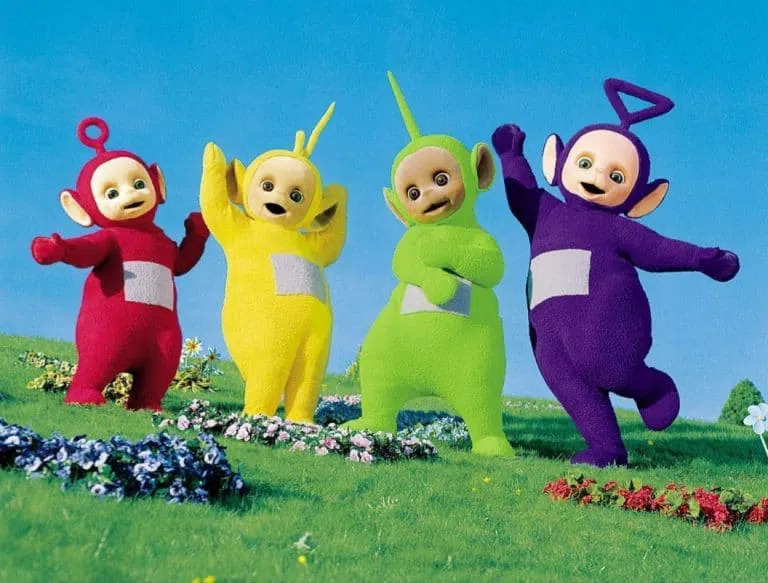
Through my tears, my gaze fell on the box my father had given me in the car. It had already been sent up to our room. I picked it up, removed the purple bow, and opened it. Inside, I found four familiar-looking characters. They were a set of soft toys, Teletubbies.
Teletubbies was a children’s television programme that became a phenomenon in the 90s. It was the silliest programme I’d ever seen, and I absolutely loved watching it, even at my age, then, seventeen. I thought each Teletubby was so adorable. Because the show was so popular and every child in the UK wanted a Teletubby, the shops couldn’t keep enough stock on the shelves, and so families were limited to buying only one per household.
My father had gone to the trouble of hunting down all four of them, the full set: Tinky Winky, Dipsy, Laa-Laa, and Po, no easy feat. He knew I’d love them and appreciate the effort.
I was so moved. It was the best present anyone could have gotten me. I remembered days forgotten, days of innocence, days of sitting on my dad’s knee, him ruffling my hair. Days of fun, laughter and dancing around the house, days before the old man, before the abuse, before the fighting at home.
It might have been my wedding day, and I was expecting a baby, but I never felt more like a child than I did that day.
(Originally published on os.me on May 28, 2021)