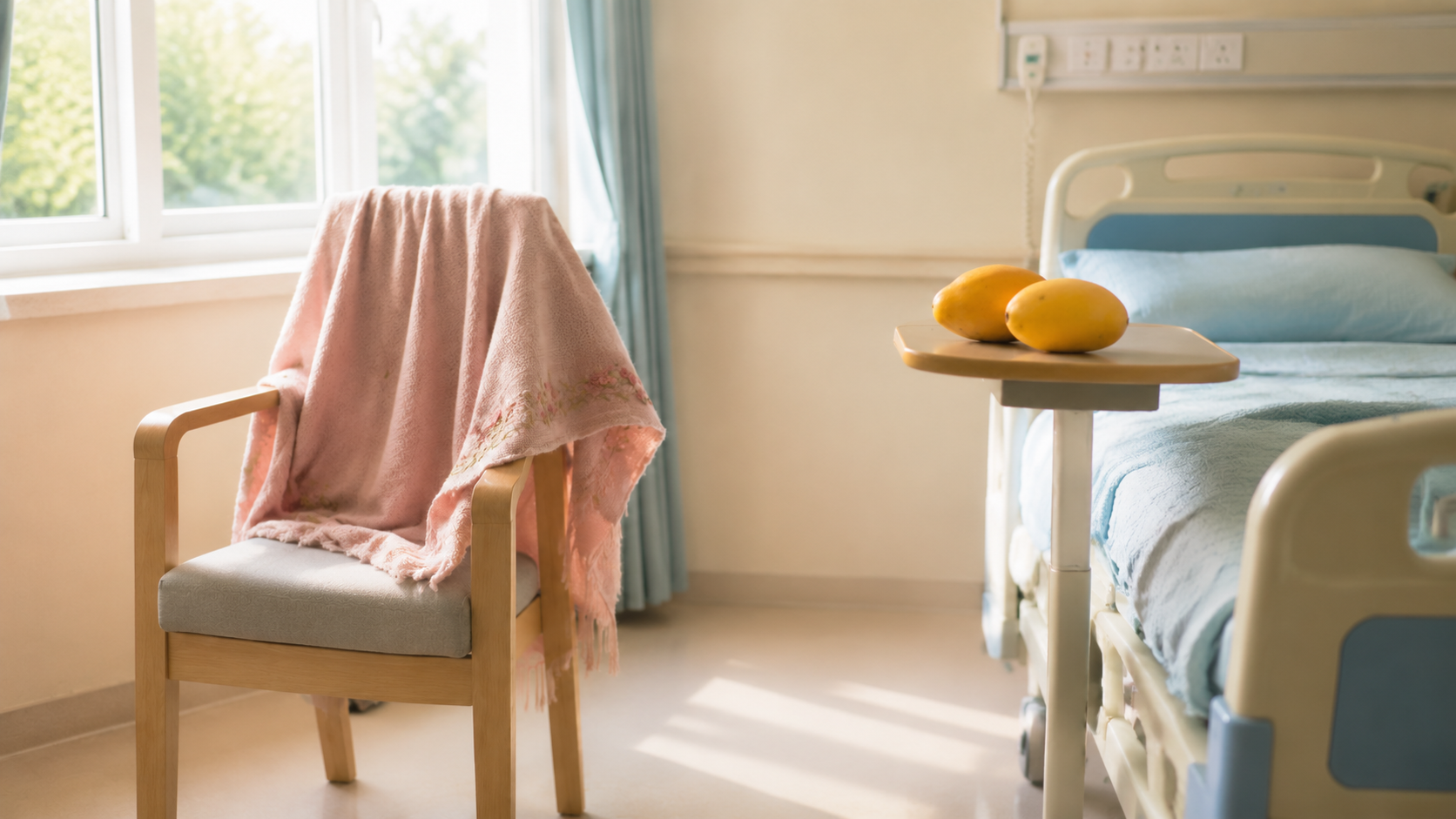
My mum has been in hospital for the past week or so.
It all happened rather suddenly. She became very unwell, there were ambulances, doctors, scans, blood tests, antibiotics, more blood tests, more antibiotics, lots of medical words flying around that I had to Google, and far too many hours spent sitting beside a hospital bed wondering what on earth was going on.
She is still there as I write this, and although I pray with all my heart that, with Divine Grace, she will be completely fine, it has been a worrying time.
But strangely, it has also been rather beautiful, I don’t quite know how else to describe it.
Somehow, amongst the pain, sickness, hospital gowns, buzzers, medication rounds, blood-pressure machines, and my repeatedly dropping things somewhere between the ward and the car park, service found us.
Mataji, even when she is unwell, notices people. She talks to the cleaners, chats to the nurses and HCAs, asks the patients around her how they are feeling and, before long, seems to know half the ward.
She has changed wards a couple of times now, so there have been different people around us at different stages of this little hospital adventure.
In one of the earlier wards there were six women in the bay. Six beds, six little worlds.
Across from Mataji was a very elderly lady, almost 100 years old, with dementia, who kept trying to get out of bed. She couldn’t walk safely and would almost certainly have fallen, and the HCA (Healthcare Assistant) was at his wits’ end trying to keep her in bed whilst also running around looking after everybody else. She was terribly confused and absolutely convinced that she was pregnant and was going to need an abortion.
I watched the poor HCA struggle for a while not knowing if I should intervene, but then I couldn’t see them both suffering any longer. I went over to the lady. I crouched on the ground where she was sat at the edge of her bed so she wouldn’t fall off and I kept gentle eye contact with her. I knew from experience there was no point telling her she wasn’t pregnant because, at that moment, it was completely real to her. I simply listened to her.
She told me she had paid 300 guineas; towards an abortion. She wasn’t sure whether she had already had the abortion or whether she was still supposed to have it. But more than anything, she was visibly shaking with fear and guilt. She was worried about what everyone would say. My heart felt wrung out for her.
I told her that if she needed an abortion, that didn’t make her a bad person. Sometimes women find themselves having to make difficult decisions in life.
I told her not to worry and that a doctor would come and see her and we would find out what was happening. She was also worried about her husband, her children and where her car was parked, although I don’t know if she had any family or a car as she never had any visitors and she had been brought in by ambulance.
When she finally felt reassured about everything, she lay down and said she would stay the night and wait for the doctor. She didn’t try to get out of bed again and the HCA was grateful.
No profound counselling technique and no great wisdom; she’d just needed somebody to enter her very confused world for a little while and make it feel less frightening.
The following morning when I saw her, the lady had received her medication and was calm. We talked a little and thankfully she had no memory of the previous day.
Another lady in the ward had Parkinson’s. Her son would come and feed her every day and look after her when he could, but then he had to go to work.
She spoke Punjabi and Hindi and her speech was difficult to understand because of her condition. Sometimes she would cry out in pain. Sometimes she was sick. Sometimes she called out to God, “Waheguru… Waheguru…”
One day she was terribly hot and sweaty underneath her blanket, and she was crying out, so with permission of the staff, I mopped her sweat from her face, removed her blanket started fanning her.
After some time, she relaxed, opened her eyes and said, “My daughter, you must be getting tired.”
“No, no, it’s okay, Mother, ” I told her. It really was okay.
Another day, when she was crying out, I realised she was trying to tell us that she was in pain, I was able to adjust her bed position as she wanted, and translate for the nurses and they gave her some medication.
Then there was an Italian lady. Now, those of you who know me know I have been learning Italian for what feels like forever, largely through Duolingo, which means I am probably very well equipped to tell someone that the elephant is wearing a blue jacket, but slightly less equipped for an emotional conversation in a hospital ward. Nevertheless, we tried.
She didn’t speak much English and I don’t speak much Italian, but somehow we had quite a long conversation. She told me that her son had died around ten years ago. As she spoke, I could see the grief still living in her eyes. Most of her family were back in Italy, mainly in the south, and she didn’t have many people here anymore. I couldn’t understand every word she said and she couldn’t understand every word I said, but it didn’t matter. I always say there is only one language, the language of love, and we all understand that.
And then there was Mataji’s neighbour. This one is a corker!
The lady in the bed beside my mother was a Gujarati lady from Mombasa, Kenya, too, just like, Mataji. She had a grey bob like Mataji wore glasses like her too.
And somehow, out of the millions of people who could have ended up in the bed next to her, she was from the same community that Mataji had married into, practically the same ancestral village.
Then we discovered something else: she had run away as a teenager to marry her husband, and so had Mataji!
Two little grey-haired Gujarati ladies, sitting beside each other in an English hospital ward, both having caused a family scandal by running away with a man about fifty years ago. What are the chances? 😄
An aunt had lovingly dropped off some Gujarati food, for me and Matajj, so we shared it with her.
We are Gujjus. Obviously food was going to become involved at some point. The lady was delighted.
On the ward where Mataji is today, there is a lady there whose husband has passed away and who told Mataji that she has nobody.
Mataji said to her, “Don’t worry. I’m here.” So now they sit and have their little chats.
I told her that I come in all the time and that if she needs anything, she just has to ask me and I’ll get it for her. I’m at the hospital so much that I tend to ask the other patients if they need anything anyway.
Sometimes somebody wants something from the dining room. Sometimes they need a book to read. Sometimes they just need a phone put on charge because the socket is behind the bed and they physically can’t reach it. Something that takes me a few seconds can make quite a difference to somebody who can’t get out of bed. Sometimes they just need an just an ear and a smile.
And I suppose that’s what so much of this has been: Little things. Nothing particularly dramatic.
Mum has had some very unwell days, but when she feels strong enough I try to get her moving. We do a few chair exercises together, I massage her head, neck and shoulders and her feet. When she has some energy, we go for a gentle walk hand in hand around the hospital. Sometimes I take her to the dining room or we sit outside on the terrace for a while so she can get some sun.
One day, we discovered the fruit seller near the hospital entrance and my mum asked for a whole box of mangoes. We took them back to the ward and gifted them to the staff. You should have seen their faces, they were so happy!
We have also given little gifts of snacks for some of the HCAs and cleaners. The cleaners especially seem to get overlooked sometimes, but they work incredibly hard. We talk to them, thank them and asks how they are.
Actually, we seem to have made friends with practically everybody now.
There have, of course, been difficult moments too. Hospitals are run by human beings, and human beings occasionally make mistakes. There was an issue with one of Mataji’s antibiotics. I was concerned because it appeared she had been given a medication despite there already being concern about a previous reaction to it.
I said what I needed to say. I was firm. But I stayed true to my principles.
One of the doctors from the consultant’s team came to apologise. She commented on how calmly and politely I had spoken to the consultant even though I was clearly making my concerns known.
That stayed with me.
There are posters all over the hospital reminding people not to shout at or abuse the staff. I find this so sad. Why do humans need reminding that abuse is wrong?
Doctors, nurses, HCAs, cleaners, porters and everyone else working in these places are dealing all day with frightened people, sick people, confused people, people in pain, relatives who are terrified, people dying, people grieving, people vomiting, people shouting and buzzers going off in every direction. Imagine doing that for twelve hours.
After seeing those posters I understood why the doctor appreciated our calm communication even more. And they took care of my mother with immense care and even more attention after that. It really does pay to be calm and respectful.
As Mataji doesn’t have enough energy to wash her hair regularly, to keep her feeling her best in between washes, I give her a little daily head massage with dry shampoo and brush it through.
The day she washed her hair, obviously there was no hairdryer at the hospital. There was, however, a little portable desk fan I had bought because the ward was so hot. Needs must.
So there I was with a round brush in one hand and a little fan in the other, attempting to blow-dry my mother’s hair in a hospital ward.
It took a while.
But eventually I got it looking lovely.
Then I put a little pink flower in her hair behind her ear.
I’ve also bought her a beautiful, bright pink poncho with embroidery on it to wear over her pink hospital gown.
It looks so cheerful and it gives her a little modesty when she is walking around because hospital gowns are not exactly known for their coverage.
With her snowy white hair freshly washed and done, the pink flower and the embroidered poncho draped around her, she looked gorgeous. The pink poncho almost looked like a sari. She wears it now whenever we go for our little walks.
One afternoon — I had left my water bottle in the car and Mataji was feeling well enough to walk that day so I held her hand and we headed towards the carpark.
As we passed the security guard, Mataji announced: “She’s kidnapping me!”
“Mataji!” I said. “You can’t say that! They’ll believe you!”
We were still laughing when we reached the multistory carpark lifts.
We got in the lift and turned around, surprised to see the security guard had followed us. He actually thought I might be kidnapping her 😂
I had to explain that we were only going to the car to give her some exercise and fetch my water bottle and that I was bringing her straight back.
Considering Mataji was happily walking along holding the hand of her alleged kidnapper in her pink poncho, I feel he might have been able to rule out a major hostage situation. Kudos to him for doing his job properly!
One day was particularly long. Mataji was feeling unwell again and so I stayed a little longer. Once she was given more medication, and settled again, and I saw she was falling asleep, I left to head home.
For some reason, as I was leaving, I suddenly had the urge to phone one of my aunts (my mother’s friend) who had just been to visit my mother the day before. I almost never call her. We message regularly and I ask how she is, but I never phone her. Those who know me, know I don’t talk on the phone at all unless absolutely necessary. I don’t know why I called her that day, but I did. I was surprised when another voice answered. It was her sister-in-law. My aunt was in hospital, and not only in hospital, in the same hospital!
She had fallen that day and fractured her shoulder and was sitting in A&E. So I did a U-turn and back into the hospital I went.
I found her in A&E and spent the next couple of hours with her until she could go home. There wasn’t much I could do medically. The hospital had done what they needed to do. But I could sit beside her and distract her. I could hold her hand and help her feel a little less frightened. When she eventually left with her sister-in-law, I went home tired but strangely happy.
Useful.
That’s the word.
Useful.
Years ago, when I was still working in the conventional sense, I remember desperately wanting my life to be useful. I didn’t know exactly what that meant, I just knew I didn’t want to spend my whole life chasing things for myself.
And now, looking around that hospital ward, I realise that service doesn’t always arrive as some organised grand project in a faraway country.
Sometimes it’s a mango.
Sometimes it’s a fan.
Sometimes it’s speaking a few terrible sentences of Italian.
Sometimes it’s listening patiently to a frightened woman tell you she is pregnant when you know she isn’t.
Sometimes it’s plugging somebody’s phone into a socket they can’t reach, or lending someone a book.
Sometimes it’s doing your mum’s hair.
Sometimes it’s sharing Gujarati food with another runaway bride.
Sometimes it’s holding your aunt’s hand in A&E.
Sometimes it’s simply saying good morning to the person in the bed opposite you.
I don’t feel that caring for and serving people makes me disappear.
Quite the opposite.
I think I become more myself.
I know spiritual life is often associated with meditation, solitude, mantra, scripture and long hours of sadhana, and all of those things are a part of my life.
But for me, what happens when I get up from the meditation seat matters most.
What is the use of sitting there trying to find God if, in daily life, and especially in times of my own crisis, I cannot recognise God in the frightened woman in the next bed? Or in the exhausted HCA? Or the cleaner? Or the doctor? Or my own mother?
Perhaps all those hours of practice are supposed to make us a little more available to the person standing right in front of us. I don’t know. I’m still learning. I only know that every time life gives me the opportunity to serve, I feel grateful. And right now, more than anything, I feel grateful for my mum. Grateful that we have each other. Grateful for our laughter. Grateful for our little walks.
Grateful for pink ponchos and portable-fan hairdryers and boxes of mangoes.
I would much rather Mataji were home, completely well, pottering about and driving me nuts.
And, with Divine Grace, I pray that very soon she will be.
But until then, I treasure these moments of closeness and sharing our light with others.
Sometimes Grace comes in ways we would never choose.
And sometimes, in the middle of a very difficult week, there is still so much love.
🧡